Teaching Kids About Money: Age-Appropriate Budget Lessons
Teaching Kids About Money: Age-Appropriate Budget Lessons
Children who learn about money early become adults who manage it well. Yet most parents feel unprepared to teach financial literacy—after all, many of us learned through expensive trial and error ourselves. The foundation starts with your own family budget.
The good news: you don't need to be a financial expert. You just need to start conversations, create opportunities for practice, and model healthy money habits. Here's your complete guide to teaching kids about money at every age.
Why Financial Education Starts at Home
Schools rarely teach personal finance. Even when they do, abstract lessons about compound interest don't stick without real-world practice. Children learn money management the same way they learn everything else—by watching their parents and trying things themselves.
Kids who grow up with money conversations are more likely to:
- Save regularly as adults
- Avoid credit card debt
- Start investing earlier
- Feel confident making financial decisions
The conversations you have now shape their financial futures.
Ages 2-4: First Money Concepts
Toddlers can't budget, but they're already forming ideas about money.
What They Can Understand
- Money is exchanged for things
- You can't have everything you want
- Waiting is sometimes necessary
How to Teach It
Play store - Set up a pretend shop with play money. Let them "buy" snacks or toys from you. This introduces the concept of exchange.
Name coins - Teach them to recognize different coins and bills. Make it a game: "Can you find the quarter?"
Explain transactions - When you pay for something, narrate it simply: "I'm giving the store money, and they're giving us groceries."
Wait for things - When they want something at the store, say "We're not buying that today, but let's put it on your wish list." This introduces delayed gratification.
What to Avoid
- Saying "We can't afford that" for everything (creates scarcity mindset)
- Hiding all money transactions (money becomes mysterious and scary)
- Giving in to every request (removes opportunity to learn waiting)
Ages 5-7: Introduction to Saving
Now they're ready for hands-on practice with small amounts.
What They Can Understand
- Saving money over time gets you bigger things
- Money is limited—choosing one thing means not choosing another
- Work can earn money
How to Teach It
Start an allowance - Even $1-2 per week gives them real money to manage. Tie it to age (1 dollar per year of age is a common approach).
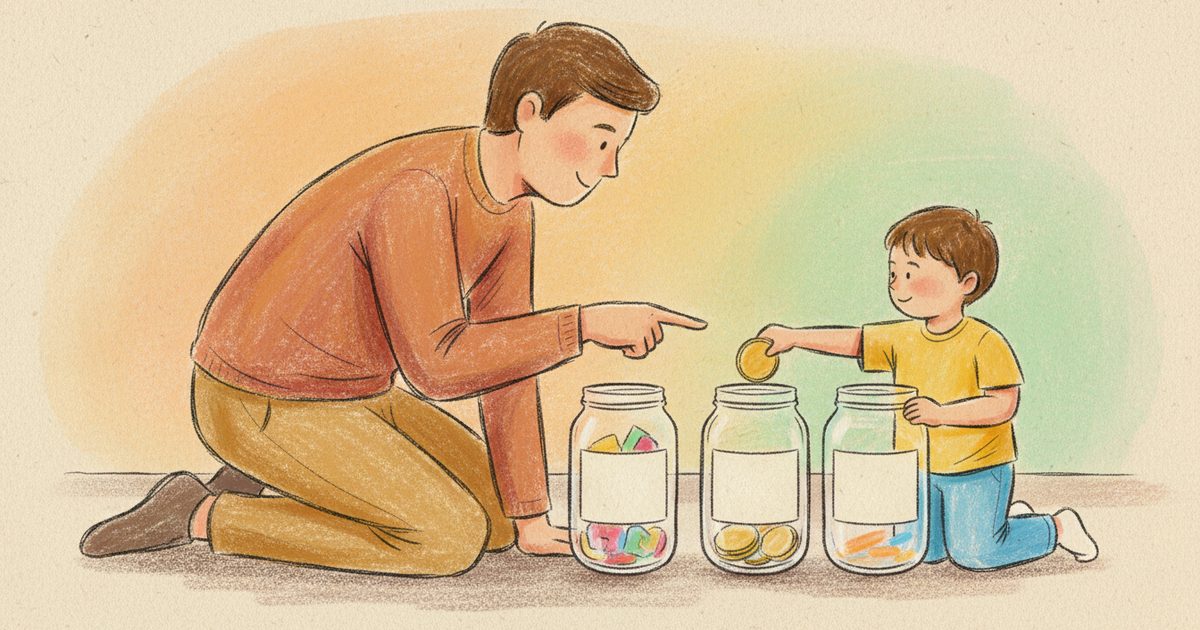
Three jars system - Give them three clear jars labeled:
- Spend (50%) - For small purchases
- Save (40%) - For bigger goals
- Give (10%) - For charity or gifts
Seeing money accumulate in clear jars makes saving tangible and exciting.
Set a savings goal - Help them choose something to save for. A $15 toy takes meaningful time to save for at $2/week—perfect for learning patience.
Count together - Weekly, count the money in each jar together. Watching numbers grow reinforces the habit.
Let them spend - When they have enough in their "spend" jar, let them buy something—even if you think it's a waste. Learning from a disappointing purchase is valuable.
What to Avoid
- Bailing them out when they overspend
- Making savings goals too ambitious (they'll give up)
- Micromanaging their spending jar
Ages 8-10: Basic Budgeting
Kids this age can handle more responsibility and more complex concepts.
What They Can Understand
- Different categories of spending
- Planning ahead for known expenses
- The difference between needs and wants
- Comparison shopping
How to Teach It
Expand the allowance - Increase both the amount and the responsibility. Perhaps they now pay for their own trading cards, small toys, or app purchases.
Let them budget for events - Going to a carnival? Give them a set amount to cover rides, games, and snacks. They decide how to allocate it.
Involve them in shopping - Bring them grocery shopping and let them compare prices. "This cereal costs $4, and this one costs $3. They're the same size. Which should we get?"
Show opportunity cost - "If you spend $10 on this game, you won't have enough for the movie next week. Which matters more to you?"
Open a savings account - Take them to the bank (or use a kid-friendly banking app) to open their own account. Watching interest appear—even pennies—teaches about money growing.
Introduce earning beyond allowance - Offer opportunities for extra work: washing the car, helping with yard work, organizing a closet. This connects effort to income.
What to Avoid
- Making money a reward for every task (basic chores are family contributions)
- Criticizing their spending choices (let natural consequences teach)
- Hiding your family's financial picture completely
Ages 11-13: Real-World Applications
Preteens are ready to see behind the curtain on family finances.
What They Can Understand
- How household budgets work
- That parents have limits too
- Basic concepts of debt and interest
- Longer-term financial planning
How to Teach It
Show them a simplified family budget - You don't need to share exact salaries, but showing categories (housing, food, savings, fun) demystifies family finances.
Give them a clothing budget - Instead of buying clothes on demand, give them a quarterly or seasonal budget. They decide what to buy. Running out means waiting.
Explain bills - When paying bills, show them what electricity costs, what internet costs. It creates appreciation and awareness.
Discuss wants vs. needs in context - When they ask for expensive items, talk through the trade-offs openly. "That gaming system costs as much as our grocery budget for a month. Let's figure out a plan."
Introduce compound interest - Use calculators to show how $100 saved at age 12 could grow by retirement. Make it visual and personal to them.
Let them experience debt (safely) - If they want something expensive now, offer to "lend" them future allowance. They'll feel how paying back with interest slows down future buying.
What to Avoid
- Burdening them with adult financial stress
- Making them feel guilty about family purchases
- Dismissing their wants as "just kid stuff"
Ages 14-17: Real Money Management
Teenagers need practice with real financial decisions before leaving home.
What They Can Understand
- Complete budget management
- Bank accounts and cards
- Saving for major goals
- How credit works
- Basic investing concepts
How to Teach It
Offer a debit card - Many banks offer teen accounts with parental controls. Real cards teach real management.
Increase scope of responsibility - Consider having them manage their own:
- Phone bill
- Transportation costs (gas money if driving)
- Entertainment budget
- School supplies and certain clothing
Encourage earning - Part-time jobs, babysitting, lawn care—earning their own money transforms how they value it.
Match their savings - For major goals (car, college, travel), consider matching what they save. This incentivizes saving while teaching about employer retirement matches.
Explain credit scores - Before they turn 18 and get bombarded with credit card offers, ensure they understand how credit works, the dangers of debt, and how to build credit responsibly.
Introduce investing - Open a custodial investment account. Even $50 in an index fund teaches concepts they'll use forever.
Include them in family financial decisions - "We're deciding between these two vacation options. Here's the cost difference. What do you think?"
What to Avoid
- Taking over when they make mistakes (unless it's catastrophic)
- Funding everything while lecturing about money
- Keeping them financially dependent while expecting independence
Conversations at Any Age
When They Say: "Can I Have This?"
Instead of: "No, we can't afford it" Try: "That's not in our plan for today, but let's talk about how you could get it"
This shifts from scarcity to problem-solving.
When They Say: "Why Can't We Buy That?"
Try: "We're choosing to spend our money on other things that are important to us, like [specific example]"
This shows money as a choice, not a limitation.
When They Ask: "Are We Poor/Rich?"
Try: "We have enough for what we need and some of what we want. We make choices about what matters most."
This normalizes intentional spending without comparison.
When You Make a Financial Mistake
Try: Being honest: "I made a mistake with money. Here's what happened and what I learned."
Modeling recovery from mistakes is as valuable as modeling success.
Common Mistakes Parents Make
Shielding Kids Completely
Hiding all financial information creates adults who are unprepared and anxious about money.
Using Money as Primary Motivation
When every behavior is rewarded with money, intrinsic motivation suffers.
Giving Without Teaching
Funding everything while saying "money doesn't grow on trees" sends mixed messages.
Expecting Perfection
Kids will make bad purchases. That's the point. Better to lose $20 at age 10 than $20,000 at age 25.
Starting Too Late
"I'll teach them when they're older" often becomes never. Start now, wherever they are.
Making It a Family Practice
Financial education works best when it's woven into daily life:
- Talk about money regularly - Not constantly, but openly
- Include kids in budget meetings - Age-appropriate involvement
- Celebrate savings milestones - Make reaching goals exciting
- Share your own journey - Age-appropriate stories about your financial learning
Tools That Help
Physical Tools
- Clear jars for young kids
- Notebooks for tracking (teaches the habit)
- Piggy banks with goal labels
Digital Tools
- Kid-friendly banking apps with parental controls
- Family budgeting apps where kids can see their categories
- Investment simulators for teens
Books and Games
- Age-appropriate money books (many exist for every age)
- Board games that involve money (Monopoly, Life, etc.)
- Simulation games with economies
The Long Game
Teaching kids about money isn't a single conversation—it's years of small lessons, allowed mistakes, and modeled behavior. Your children are watching how you handle money, stress about money, talk about money.
The goal isn't to raise kids who never make financial mistakes. The goal is to raise kids who understand money, can recover from mistakes, and have the tools to build the financial life they want.
Start today with one conversation, one opportunity, one small lesson. Your children's financial futures will thank you.

Written by
Rafał GawlikFounder of FamilyJar
Rafał Gawlik is the founder of FamilyJar, and a husband and father based in Kraków, Poland. He writes about family budgeting, the envelope method, and building financial security as a couple — drawing on the real-world workflows behind the FamilyJar app and his own experience running a household budget.